Showing posts with label Research Ethics. Show all posts

Friday, November 6, 2015

Three Guys Talking About Scales

What follows below is the result of an online discussion I had with psychologists Brent Roberts (BR) and Michael Frank (MF). We discussed scale construction, and particularly, whether items with two response options (i.e., Yes v. No) are good or bad for the reliability and validity of the scale. The answers we came to surprised me--and they might surprise you too!

MK: Twitter recently rolled out a polling feature that allows its users to ask and answer questions of each other. The poll feature allows polling with two possible response options (e.g., Is it Fall? Yes/No). Armed with snark and some basic training in psychometrics and scale construction, I thought it would be fun to pose the following as my first poll:
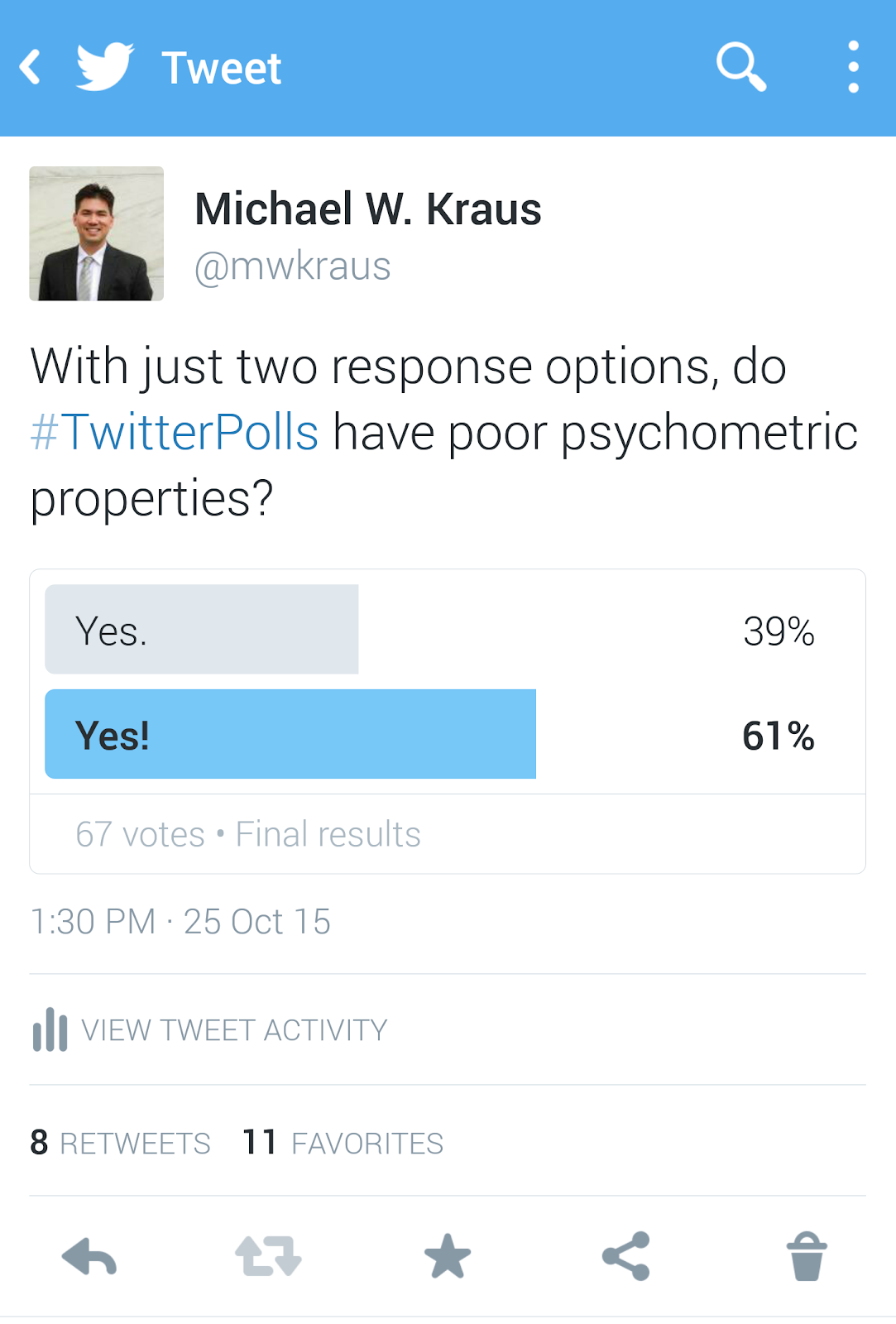

Screenshot_2015-10-26-20-00-55.png

Said training suggests that, all things being equal, some people are more “Yes” or more “No” than others, so having response options that include more variety will capture more of the real variance in participant responses. To put that into an example, if I ask you if you agree with the statement: “I have high self-esteem.” A yes/no two-item response won’t capture all the true variance in people’s responses that might be otherwise captured by six items ranging from strongly disagree to strongly agree. MF/BR, is that how you would characterize your own understanding of psychometrics?

Tuesday, May 27, 2014

Notes on Replication from an Un-Tenured Social Psychologist

Last week the special issue on replication at the Journal of Social Psychology arrived to an explosion of debate (read the entire issue here and read original author Simone Schnall's commentary on her experience with the project and Chris Fraley's subsequent examination of ceiling effects). The debate has been happening everywhere--on blogs, on twitter, on Facebook, and in the halls of your psychology department (hopefully).

Thursday, April 17, 2014

(Sample) Size Matters

Sample Size Matters
On this blog and others, on twitter (@mwkraus), at conferences, and in the halls of the psychology building at the University of Illinois, I have engaged in a wealth of important discussions about improving research methods in social-personality psychology. Many prominent psychologists have offered several helpful suggestions in this regard (here, here, here, and here).

Among the many suggestions for building a better psychological science, perhaps the simplest and most parsimonious way to improve research methods is to increase sample sizes for all study designs: By increasing sample size researchers can detect smaller real effects and can more accurately measure large effects. There are many trade-offs in choosing appropriate research methods, but sample size, at least for a researcher like me who deals in relatively inexpensive data collection tools, is in many ways the most cost effective way to improve one's science. In essence, I can continue to design the studies I have been designing and ask the same research questions I have been asking (i.e., business-as-usual) with the one exception that each study I run has a larger N than it would have if I were not thinking (more) intelligently about statistical power.

How has my lab been fairing with respect to this goal of collecting large samples? See for yourself:

Thursday, March 13, 2014

I'm Using the New Statistics

Do you remember your elementary school science project? Mine was about ant poison. I mixed borax with sugar and put that mixture outside our house during the summer in a carefully crafted/aesthetically pleasing "ant motel." My prediction, I think, was that we would kill ants just like in the conventional ant killing brands, but we'd do so in an aesthetically pleasing way. In retrospect, not sure I was cut out for science back then.

Anyway, from what I remember about that process, there was a clear study design and articulation of a hypothesis--a prediction about what I expected to happen in the experiment. Years later, I would learn more about hypothesis testing in undergraduate and graduate statistical courses on my way to a social psychology PhD. For that degree, Null Hypothesis Significance Testing (NHST) would be my go-to method of inferential statistics.

In NHST, I have come to an unhealthy worship of p-values--the statistic expressing the probability of the data showing the observed relationship between variables X and Y, if the null hypothesis (of no relationship) were true. If p < .05 rejoice! If p < .10 claim emerging trends/marginal significance and be cautiously optimistic. If p > .10 find another profession. By NHST standards, an experiment fails or succeeds based solely on this one statistic.

When the Association of Psychological Science proposed using an alternative statistical approach--something called the New Statistics (actually not new, been around for decades)--I was intrigued about the possibility of living an academic life beyond the tyranny of p < .05.

Wednesday, November 6, 2013

Look Everyone: A Social Priming Finding with Direct Replications!

If you visit this blog occasionally (or follow me on twitter, because of course!) then you know that social psychology has come under criticism recently for its lack of integrity in research methods and the complete absence of exact replication. The criticism has been strongest with respect to a subfield in social psychology known as social priming. Social priming refers to a now classic psychological phenomenon where the activation of one social concept in memory can elicit changes in behavior, physiology, or self-reports of a related social concept without conscious awareness. Social priming has been used to explain why reading words related to elderly concepts (e.g., Florida, retire) can lead you to walk slower (although, this particular social priming finding does not replicate across different laboratories).

The criticism about social priming stems from (a) a growing number of high profile replication attempts of classic findings that failed, (b) the steady stream of fanciful/unbelievable social priming effects that appear in glamour psychology journals (e.g., messyrooms make people more creative), and (c) the inappropriate reactions of prominent social priming researchers to this scrutiny (e.g., criticizing the scientific integrity of replication attempts and the journals that publish those attempts). It’s been like watching a car wreck in super slow motion!

Wednesday, September 18, 2013

SWAG: My favorite reason to "Just Post It!"

Every Wednesday Thursday afternoon, I gather with a bunch of faculty and graduate students at the University of Illinois to discuss a journal article about social psychology, and to eat a snack. This blog post reflects the discussion we had during this week's seminar affectionately called Social Wednesdays Thursdays and Grub (SWTAG)--we're going STAG now!

In last week's journal club we read about a recent paper in Psychological Science with a very clear message: It should be the norm for researchers to post their data upon publication. In the article, the author (Uri Simonsohn) lays out the major reason why he thinks posting data is a good idea: It helps our field catch scientific fraud in action (e.g., fabricated data). Simonsohn details some methods he has used in the past to catch fraud in the paper and on his new blog over at datacolada.org (I'll have mine blended!).

I agree that posting data will make it harder for people to fabricate data. However, my favorite reason to increase norms for posting data has nothing to do with data fabrication.

Wednesday, August 21, 2013

External Validity and Believability in Experiments

Imagine for a moment that you are an experiment participant in a dystopian future university thirty years from now. At birth, you were taken from your natural parents and assigned to two robotic parental unit alternatives. The first unit is cold and metal, it has a big frowny face, and all it's good for is dispensing the occasional hot meal through it's midriff. The second unit provides no food, but this unit is fashioned with a luxurious coat of fine fur that feels warm to the touch.

Months pass as you are raised by these two robotic parental units. As you descend further and further into madness, every move you make is video recorded by a pair of enterprising future psychologists who are seeking an answer to one question: Will you spend more time with the cold, metal, food-dispensing robot or the furry one? Surprisingly, though the metal robot fulfills your metabolic needs, the researchers are fascinated to find that you spend most of your time with the furry mother surrogate.

What do results from an experiment such as this (famously conducted by Harry Harlow on monkey's in the 1950's) tells us about the nature of social relationships, love, and survival? Do they tell us anything about the human/monkey experience? Or are the conditions of the experiment so artificial in nature, that they obscure our ability to draw insights about basic psychology? I consider these questions in today's post.

Wednesday, June 19, 2013

Quality v. Quantity in Publication

Einstein says Quality not Quantity (source)
I was on twitter the other day (mwkraus, why aren't you following me?) and my twitter feed displayed a great quote from Albert Einstein with some important career advice for aspiring scientists: He said something like "a career in which one is forced to produce scientific writings in great amounts creates a danger of intellectual superficiality." This quote got me wondering about the career trajectories of aspiring social psychologists, and the tension between wanting to publish as much as possible, and wanting to publish only the very best research. I consider this tension in today's blog.

Thursday, February 21, 2013

Have Your Cake and Eat It Too! Practical Reform in Social Psychology

The cake we can (1) have, and (2) eat!
If you have been following recent headlines in the social sciences then you are aware that the field of social psychology has been in some rough water over the past three years. In this time period, we've had our flagship journal publish a series of studies providing evidence that ESP exists (and then refuse to publish non-replications of these studies). We've suffered through at least three instances of scientific fraud perpetrated by high profile researchers who engaged in egregious scientific misconduct. We've had an entire popular area of research come under attack because researchers have failed to replicate its effects. And several respected members of the science community have had some harsh words to say about the discipline and its methods.

Listing all of these events in succession makes me feel a bit ashamed to call myself a social psychologist. Clearly our field has been lacking both oversight and leadership if all of this could happen in such a brief period. Now, I'm not one to tuck my tail between my legs. Instead, I've decided to look ahead. I think there are relatively simple changes that social psychologists (even ones without tenure) can make in their research that can shore up our science going forward.

Sunday, September 30, 2012

Science Utopia (Continued): Methods Integrity Workshop

"Winter is coming." --Ned Stark/Greg Francis
On Friday afternoon I attended a seminar in methods integrity in research (here). The speakers were Hal Pashler of UC San Diego and Greg Francis of Purdue University. In the seminar, the speakers raised a number of interesting points that I think add to last week's post on PYM about questionable research practices (here). I'll summarize the main points that I took from the seminar:

Monday, September 24, 2012

Science Utopia: Some Thoughts About Ethics and Publication Bias

Science Utopia, next exit
Psychology's integrity in the public eye has been rocked by recent high profile discoveries of data fabrication (here, here, and here) and several independent realizations that psychologists (this is not unique to our field) tend to engage in data analytic practices that allow researchers to find positive results (here, here, and here). While it can be argued that these are not really new realizations (here), the net effect has turned psychologists to the important question: How do we reform our science?

It's a hard question to answer in one empirical article, or one blog post, and so that's not the focus here. Instead, what I'd like to do is simply point out what I think are the most promising changes that we, as a science, can adopt right now to move toward a solution that will help prevent future data fabrication or the use of biased hypothesis tests. These are not my ideas mind you, rather, they are ideas brought up in the many discussions of research reform (online and in person) that I have had formally and informally with my colleagues. Where possible, I link to the relevant sources for additional information.

Monday, August 6, 2012

Behind the Scenes of Psychological Research: What Does the Future Hold?


Since starting this blog, I’ve told you about interesting and hopefully useful research findings. But today I wanted to take a step back and share with you a bit about what is going on behind the scenes of psychological research. We assume that findings we are telling you about—those which are published in peer-reviewed journals—are true, but it turns out that is not always the case. Recently, it has come to light that the way we conduct our studies may be leading us to find “significant results” more often than they truly exist. And even more extreme than problems with methodology is the harsh reality that some researchers may be simply making up their findings. So today, I wanted to share with you some of my personal experience behind the scenes of science, as well as three great suggestions I’ve heard for reforming our scientific ways.

Sunday, May 20, 2012

More Authors or Less Authors?

source
In my brief time in research I have written journal articles authored by as few as two people and as many as six people. Many of those authors have been faculty members (senior researchers who provided me with valuable mentoring), colleagues (graduate students with similar experience and training), and trainees (early researchers learning the research process from me and others). This experience has got me wondering: What is the best combination of authors for writing a research paper? Is it better to have more authors or less authors? I consider these questions in today's post!

I should note that many of these challenges apply to any form of collaborative work, and not just research.

Thursday, February 9, 2012

Friday Fun: One Researcher's P-Curve Analysis

It's Me!
Two weeks ago when PYM was at the annual conference of the Society for Personality and Social Psychology, I went to a symposium about false-positive findings in psychology (see my summary here). In the symposium, the speakers discussed the prevalence of research practices that result in biased statistical testing. In that symposium, one of the researchers, Uri Simonsohn, presented a method for catching people who engage in these practices: the P-curve analysis. What follows is a p-curve analysis of one researcher/blogger: Michael W. Kraus!

Thursday, February 2, 2012

The Bachelor: A modern-day replication of the Stanford Prison Experiment?

Bachelor Ben and his ladies.
In 1971 a group of Stanford researchers led by psychologist Philip Zimbardo conducted what became a famous study of the power of  deindividuating situations. Within only six days, twenty-four seemingly normal, psychologically healthy participants were transformed into sadistic prison guards and dejected, emotionally unstable prisoners who came to voluntarily tolerate the abuse that was inflicted on them.

Thirty-one years later, the first episode of "The Bachelor" was aired on ABC. During the show, twenty-five single women compete for the affections of one man (with the reverse in "The Bachelorette") as they travel to scenic destinations, ride in lots of helicopters and boats, and enjoy lavish accommodations. What could the Stanford Prison Experiment possibility have to do with a fun, light-hearted reality show? A lot, it turns out.

Monday, January 16, 2012

Is Graduate School a Ponzi Scheme?

A couple of years ago, this article ran in the Economist. In the article, the author takes the point of view that the pursuit of a PhD degree is a waste of time. Whether or not you agree with this perspective, it is important to consider the points being made. If you are, or have been, a graduate student, you probably learned much of this during your time in graduate school.

Friday, October 7, 2011

Friday Fun: Breaking News! Correlation Does Not Equal Causation

Man and IPhone pictured in loving embrace (source)
Right now I am teaching a personality psychology class and we are talking about research methods. Invariably, anytime I teach psychological methods I always end up talking about correlations--specifically, that a correlation is an association between two variables and nothing more. The important point is that correlations--even those that come from fancy associations between behavior and brain images--do not mean causation. Students are typically quite receptive to this information.

It's too bad that some journalists (and to be fair, even some scientists) forget this lesson. 

Just for fun, I gave out extra credit this week to any student who could find a news article claiming causation from correlation. I gave my students a 6 hour time window to complete this assignment. Not surprisingly, half my class of 60 students came back with a unique example (for those keeping score at home, that's 30 news articles that inappropriately infer cause from correlations)! Below, I summarize my three favorites:

Friday, July 8, 2011

Friday Fun: A Look Back At The Milgram Experiment

In 1963, Stanley Milgram published perhaps the single most important piece of research in the history of social psychology. His Behavioral Study of Obedience experiment is among the most influential studies of all time, and is still being taught today in psychology classes everywhere. 

source
The experiment was designed to take place in laboratory room where the goal was to study learning and memory as part of a Yale psychology experiment. There were 40 total participants between the ages of 20 and 50 from the surrounding New Haven community. All different types of occupational grades and education levels were represented among these participants, though they were all men. Once at the experiment, participants were instructed that they would be teaching another man--their partner-- some word associations. If the partner got any of the answers wrong, participants would deliver a slight shock. As the partner continued to get answers wrong, the shock could potentially increase to painful levels. The final shock intensity was 450 volts, and was labeled with an XXX.