Showing posts with label Current Events. Show all posts

Friday, November 6, 2015

Three Guys Talking About Scales

What follows below is the result of an online discussion I had with psychologists Brent Roberts (BR) and Michael Frank (MF). We discussed scale construction, and particularly, whether items with two response options (i.e., Yes v. No) are good or bad for the reliability and validity of the scale. The answers we came to surprised me--and they might surprise you too!

MK: Twitter recently rolled out a polling feature that allows its users to ask and answer questions of each other. The poll feature allows polling with two possible response options (e.g., Is it Fall? Yes/No). Armed with snark and some basic training in psychometrics and scale construction, I thought it would be fun to pose the following as my first poll:
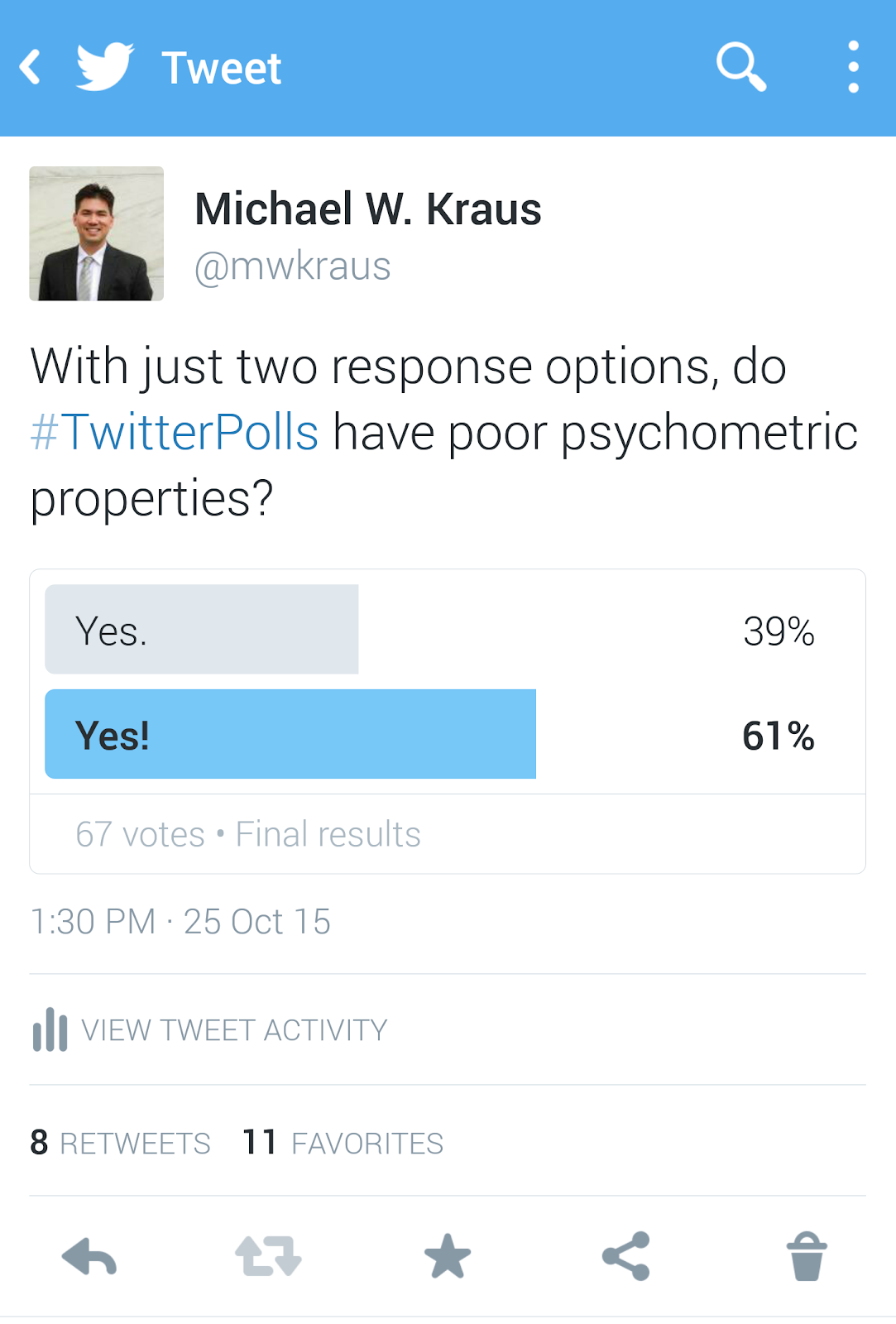

Screenshot_2015-10-26-20-00-55.png

Said training suggests that, all things being equal, some people are more “Yes” or more “No” than others, so having response options that include more variety will capture more of the real variance in participant responses. To put that into an example, if I ask you if you agree with the statement: “I have high self-esteem.” A yes/no two-item response won’t capture all the true variance in people’s responses that might be otherwise captured by six items ranging from strongly disagree to strongly agree. MF/BR, is that how you would characterize your own understanding of psychometrics?

Thursday, September 24, 2015

Thought Fragments Concerning Ideology in Social Science

I took a course in sociology my first year as an undergraduate at UC Berkeley. The course was an introduction to sociology taught by professor and social activist, Harry Edwards. The course blew me away because it felt so viscerally real. Professor Edwards would talk about social class, race, and gender in America and students would chime in about their own experiences that brought these big social constructs to life. What I learned in Professor Edwards’ class resembled nothing we had discussed in my high school history classes—I grew up in a politically conservative suburb in San Diego, and we didn’t have much ideological diversity in our discussions of law and society. Sociology, and social sciences more broadly, really spoke to me.

Thursday, March 26, 2015

Gender Imbalance in Discussions of Best Research Practices

Over the last couple of weeks there have been some really excellent blog posts about gender representation in discussions of best research practices. The first was a shared Email correspondence between Simine Vazire and Lee Jussim. The second was a report of gender imbalance in discussions of best research practices by Alison Ledgerwood, Elizabeth Haines, and Kate Ratliff. Before then (May 2014), Sanjay Srivastava wrote about a probable diversity problem in the best practices debate. Go read these posts! I'll be here when you return.

Tuesday, October 28, 2014

Everyone Gets a Job!

A terrifying graph for any PhD student! (source)
It's late October and that means we are squarely in the middle of job season for psychology PhDs (and PhD candidates). I was hired during the 2011-2012 job cycle, and so I recently switched to the evaluation side of the job process. Sitting on this side of the fence I feel incredibly fortunate to have a job: There are a ton of accomplished graduate students and postdocs with strong records, interesting research ideas, and stellar (!!!) letters of recommendation. If the system were running optimally, most of these applicants would land jobs. If the system were running optimally...

Tuesday, August 19, 2014

Big Theory

"Essentially, all models are wrong, but some are useful." --George Box*

I need to be honest with you, I'm not all that good at generating novel ideas: Some of my most well-cited papers involve theories that sociologists came up with decades ago; Reviewers frequently accuse me of running post-hoc analyses (asking the data for ideas, rather than generating apriori predictions); When media cover my research, the most common initial comment is something like: "This is so obvious....blah, blah....you suck." You get the idea. 


I don't view this particular characteristic of my research as a flaw. Rather, I'm acknowledging that not all scientists can be ground-breaking theorists/game changers: Some people come up with great ideas and some people test them. For the most part, I test theories and I do it in (what I hope are) convincing ways. Given this characteristic of my research, you might be surprised then, to learn that I love theory!** 


You read that right.

Thursday, April 17, 2014

(Sample) Size Matters

Sample Size Matters
On this blog and others, on twitter (@mwkraus), at conferences, and in the halls of the psychology building at the University of Illinois, I have engaged in a wealth of important discussions about improving research methods in social-personality psychology. Many prominent psychologists have offered several helpful suggestions in this regard (here, here, here, and here).

Among the many suggestions for building a better psychological science, perhaps the simplest and most parsimonious way to improve research methods is to increase sample sizes for all study designs: By increasing sample size researchers can detect smaller real effects and can more accurately measure large effects. There are many trade-offs in choosing appropriate research methods, but sample size, at least for a researcher like me who deals in relatively inexpensive data collection tools, is in many ways the most cost effective way to improve one's science. In essence, I can continue to design the studies I have been designing and ask the same research questions I have been asking (i.e., business-as-usual) with the one exception that each study I run has a larger N than it would have if I were not thinking (more) intelligently about statistical power.

How has my lab been fairing with respect to this goal of collecting large samples? See for yourself:

Wednesday, April 2, 2014

The Psychology of Economic Inequality: A Collection

Today I wrote an op-ed piece for livescience about economic inequality. Read the piece here. In it, I argue that though economic inequality is a complex social and political issue, it may be explained, at least in part, in terms of the basic psychological motivations of individuals.

Anyway, I hope you'll check out the piece and send me comments via twitter (@mwkraus). If you'd like to read more about this area of research, below I have collected four past PYM pieces on the topic.

Friday, February 7, 2014

Ten Findings About Facebook for its 10th Birthday


Happy Birthday, Facebook!
Over the past ten years, Facebook has added a new dimension to the social lives of over a billion people. Given its popularity, it has become the topic of a growing body of research in the social sciences. For Facebook’s 10th birthday, I collected ten discoveries this research has yielded and share brief summaries below. If you’re on Facebook, then this research applies to you! Happy birthday, Facebook!

1. Does Facebook help us feel better by fulfilling our need for social connection? The authors of one study text-messaged people five times per day for two weeks and asked people about their Facebook use and their well-being. The more people used Facebook at one time, the worse they felt the next time they were text-messaged. In addition, over the two weeks of the study, the more people used Facebook, the more their life satisfaction decreased.

Wednesday, February 5, 2014

PYM's Graduate Student Guide-Blog

In thinking about the past three years writing for PYM, I just realized that I write a lot of posts about issues that graduate students care about. I've made a list with links to each of these posts below. Now all the "wisdom" I have to offer about graduate school is in one place. I hope this will help you--current and future graduate students in psychology--to navigate the challenges and opportunities that many of us face on our way to a PhD! Good luck in your journey and don't be afraid to leave comments or questions on the post or on twitter (@mwkraus or @psychyourmind).

Wednesday, January 8, 2014

Mo Money, Mo Problems? Affluenza Doesn't Exist

Affluenza? Doesn't exist! (source)
"I don't know what they want from me,
It's like the more money we come across,
The more problems we see."
--The Notorious BIG

Some people think that the rich live hard knock lives-- I was first made aware of this hypothesis by these lyrics written by the '90s hip hop icon the Notorious BIG. Admittedly, I haven't given much thought to this idea all the way up until last December. It was at that time that a teenage drunk driver caused an accident, leaving four people dead. A judge sentenced the teenage boy to 10 years probation and therapy. The judge was lenient, in part, based on the defense's claims that the boy was afflicted with a rare illness known as affluenza, which, according to the LA Times is "a syndrome that keeps someone from a wealthy background from learning that bad behavior has consequences."

It seems the news media has caught the affluenza bug in the weeks since this story ran: Just this week I came across an article about affluenza in that paragon of journalistic integrity, the Huffington Post. The article reads "Though often used in jest, the term (affluenza) may have more truth than many of us might think." It appears that some journalists are taking the term seriously (oh and hooray, I'm QUOTED in the friggin' article). The same day this article appeared online I was asked to participate in an internet discussion about... affluenza (I declined).

I wrote this blog post today, under a blanket shielding me from the polar vortex outside, to make one small point: NO NO NO NO NO!!!! Stop It!!! Affluenza does not exist!!! EXCLAMATION POINTS!!!

Tuesday, January 7, 2014

The psychology within the biggest news of 2013


source
As we ring in the new year, every major news outlet is publishing their “top” lists of 2013: the top movies, the top tweets, the top sports moments, the top medical breakthroughs, the top business blunders - the lists go on and on. To add a bit of psychology to this “top” list trend, in this post, I take the three top news stories of 2013 as chosen by CNN.com’s readers and highlight what psychological research can contribute to each of them.

source
1. New pope. When the 266th pope of the Catholic Church was elected this year, many praised him for his commitment to interfaith dialogue. His support of cross-religious interactions underscores his belief that communication between members of different groups can help to reduce prejudice and conflict. Seeking to heal rifts among people due to religious differences or prior conflicts, the pope himself has sought out personal relationships with many religious leaders across the globe. He hopes that by encouraging his followers to establish similar interfaith relationships, current tensions can be quelled and prejudice alleviated.

source
Research on the intergroup contact hypothesis tells us that the pope’s strategy is likely a good one. The basic prediction of the hypothesis is that contact between people of different groups will usually reduce prejudice. Forming relationships with members of another group can help people learn more about a group, experience less anxiety about interacting with the group, and feel more empathy for that group. All three of these outcomes can then diminish prejudice. Some research has even shown that merely having a friend who interacts with someone from another group can reduce prejudice (the extended contact hypothesis). While it’s not always the case that intergroup contact yields less prejudice, the pope does seem to be taking the right approach for prejudice reduction by continuing to support interfaith dialogue.

Friday, October 18, 2013

The Science of Touch and Emotion

Today we have a guest post by a blogger for the Berkeley Science Review on the science of touch and emotion. BSR will be hosting an event about touch on October 27th. For more info, go to the bottom of this post.

Source
If someone told you it was possible to communicate gratitude to a complete stranger with a two second touch, would you believe it? Although the power of speech allows us to imbibe great subtlety and complexity in our messages, psychological researchers have demonstrated that something as complex as gratitude or sympathy can be communicated with a simple touch.

In social species, prosocial emotions are those that promote the well-being of the group. By engaging in acts of trust and cooperation, social groups survive. Parents and offspring form attachments, and individuals act in mutually beneficial, altruistic ways to sow trust between one another. A growing number of studies on touch and emotion reveal our deep-seated need for human contact and warmth. Touch may be the key for communicating prosocial emotions, and for promoting group cohesion and survival.

Wednesday, September 18, 2013

SWAG: My favorite reason to "Just Post It!"

Every Wednesday Thursday afternoon, I gather with a bunch of faculty and graduate students at the University of Illinois to discuss a journal article about social psychology, and to eat a snack. This blog post reflects the discussion we had during this week's seminar affectionately called Social Wednesdays Thursdays and Grub (SWTAG)--we're going STAG now!

In last week's journal club we read about a recent paper in Psychological Science with a very clear message: It should be the norm for researchers to post their data upon publication. In the article, the author (Uri Simonsohn) lays out the major reason why he thinks posting data is a good idea: It helps our field catch scientific fraud in action (e.g., fabricated data). Simonsohn details some methods he has used in the past to catch fraud in the paper and on his new blog over at datacolada.org (I'll have mine blended!).

I agree that posting data will make it harder for people to fabricate data. However, my favorite reason to increase norms for posting data has nothing to do with data fabrication.

Saturday, September 14, 2013

A Single Factor Model for Success in Graduate School

Graduate School: The Playground of the Mind
If you've come to the internet more than once, then you know that blogs often discuss the difficulties of coming out of graduate school with a tenure track faculty appointment in psychology or other fields (here and here). For those of you out there considering a research career at a major university--keep in mind that it's not for everyone. PYM has also tried its hand at one or two lists of traits needed to succeed in graduate school. These lists have been inspired by others. Together, success lists make it seem like graduate success is a product of a number of personality factors and situational variables that people have very little control over.

But, what if I told you that success in graduate school is much simpler than considering all these complex person X situation interactions? What if whether you sink or swim is really just about one key ingredient? Today I present a single factor model for success in graduate school!

Sunday, August 18, 2013

Psych-Your-Mind: Now (Facebook) Official!

wikipedia.org
Hello everyone! As many of you know, our blog has been plugging along for two years now. We've discussed all manner of psychology-related issues--from ESP to gaslighting, and everything in between. Most of you have arrived here because you know one of the bloggers at PYM, you love psychological SCIENCE, or you're my mom (Hi Mom!). Some may have even found their way here through our various social media posts on twitter (mwkraus, psychyourmind) or even on google+ (which is looking more like a wasteland of social media).

Wednesday, August 14, 2013

The Psychology of the "Psychology Isn't a Science" Argument

Tom knows a pseudoscience when he sees one! (wikipedia.org)
Every so often the internet is set ablaze with opinion pieces on a familiar question: Are "soft" sciences, like psychology, actually science? Most of the time the argument against psychology as a science comes from people from the so-called harder sciences (you know, people who don't know ish about psychology). Of course, every once in a while we throw ourselves under the bus by declaring that for our softer sciences to be taken seriously, we must be more like the real sciences. You're still reading this so most likely you are interested in my opinion on this topic. With a quick nod to others who have covered this topic herehere, here, and here, let's review some of the arguments for and against psychology as a science in what follows.

Monday, July 1, 2013

What Grinds My Gears? Media Coverage of Emotion Research

What's in a facial expression of emotion? (source)
Last week Boston Magazine published an article (here) claiming a "new theory" of emotion. The article then challenged the idea that emotions are signaled and perceived universally through unique facial expressions (like we've discussed here). The article purports to be a take-down of famous emotion researcher Paul Ekman*--whose work has been popularized on such television shows as Lie to Me. Here is why I hated this article:

Wednesday, June 19, 2013

Quality v. Quantity in Publication

Einstein says Quality not Quantity (source)
I was on twitter the other day (mwkraus, why aren't you following me?) and my twitter feed displayed a great quote from Albert Einstein with some important career advice for aspiring scientists: He said something like "a career in which one is forced to produce scientific writings in great amounts creates a danger of intellectual superficiality." This quote got me wondering about the career trajectories of aspiring social psychologists, and the tension between wanting to publish as much as possible, and wanting to publish only the very best research. I consider this tension in today's blog.

Tuesday, June 18, 2013

Psychology At the Movies: Essentialist Musings in Man of Steel

www.imdb.com
Yesterday, my spouse and I dropped our newborn daughter off with Grandma and then popped over to the local theater to see this summer's much anticipated comic-book blockbuster Man of Steel. By any standard, Man of Steel is exceptionally light when it comes to philosophical musings: The plot is predictably linear--good guys fight bad guys who are trying to kill them. At first glance, it may seem like a stretch to write an entire blog entry (for a psychology blog) about the film, given this simple plot design. But, in between the explosions--and there were MANY explosions--the bad guys turned out to be motivated by some very simple psychological principles. Spoilers Ahead!

Tuesday, June 11, 2013

This is NOT advice for first year faculty

Hello again, PYM readers. It is now June and I just finished my first full academic year as a faculty member at the University of Illinois, Urbana-Champaign (Chambana). Having just passed through the rabbit hole, I have returned mostly unscathed to blog a bit about my experience. As this is just my first year, I don't have any advice that will help others who are transitioning to professor-hood, rather, this post reflects some of the things that I think people (like me) deal with during their transition to a new faculty job. Onward!