Showing posts with label Power. Show all posts

Monday, August 25, 2014

Does Power Help or Hurt Perspective-Taking?


First comes love, then comes the realization that we are navigating life’s journey with another person who may have different thoughts, feelings, and beliefs than us. How do we deal with having differing viewpoints from our romantic partners? Perspective-taking is a fundamental social skill that helps us smoothly steer through the many bumps in the road, from picking out a thoughtful anniversary gift to helping us reach a compromise on a contentious issue. When people are able to consider their partner’s point of view, both they and their partners report being more satisfied with their relationship (Long, 1990). Although this basic skill is fundamental and beneficial, not everyone is good at perspective-taking, particularly in their romantic relationships (Kenny & Acitelli, 2001). So who is good at perspective-taking and who is lacking? To answer this question, I turned to the research on power. I was curious to find out whether feeling powerful in a romantic relationship might lead people to be better, or worse, perspective-takers.

Power is potent, affecting how people think, feel, and interact with others. Although thinking about powerful people might bring to mind the caricature of a power-hungry CEO, the reality is that power is not just in the workplace, it is part of all of our relationships, shaping how we interact with our parents, friends, and romantic partners. So how exactly does it shape our relationships? Or, in our case, our ability to step into our partner’s shoes? Well, the old adage, “power corrupts,” suggests that powerful people should be selfish, caring only about getting their own way and paying little attention to what their romantic partners are thinking and feeling. And there is research to support this – people are less likely to take strangers’ perspectives when they feel powerful (Galinsky et al., 2006) and in families, powerful members are less likely to perspective take (Barber, 1984). But on the other hand, for romantic relationships to survive, people can’t just be selfish—they have to think about what is best for the relationship, which means considering their partner’s point of view. Power helps people focus on and pursue their goals (Guinote, 2007), so perhaps power might actually help people become better perspective-takers in romantic relationships because it focuses them on maintaining their relationship?

Sunday, November 25, 2012

What is Charisma?


Did charisma win the 2012 election?
Today on PYM we are pleased to bring you the second guest blog from Emily Plutov, advanced undergraduate at the University of Illinois, Urbana-Champaign.

In some of PYM’s election coverage, Amie cited an example of the incredible influence television has over voters’ conceptions of political figures: the famous debate between John F. Kennedy and Richard Nixon in 1960. In this debate, Kennedy was the clear victor; not only was he calm and collected, but he also was said to have displayed “charisma,” an attribute that people widely believe makes politicians into effective leaders.

What is charisma?

Monday, October 15, 2012

Is there a feminine side to dominance?


Is there a female dominance hormone? (source)
Today on PYM we are pleased to bring you a guest blog from Emily Plutov. Emily is an advanced undergraduate at the University of Illinois, Urbana-Champaign, who has recently become interested in social psychology research on power and dominance.

When it comes to research on the hormonal correlates of dominance behaviors, what becomes clear is that males have garnered considerable attention within this sphere. As Michael mentioned in a previous post, testosterone (an androgen which is produced in the testes in men and the adrenal gland in both men and women), is linked to dominance in men. 

What about women?

Wednesday, June 27, 2012

When "He's Just Not That Into You" Backfires

Source
The popular self-help book He's Just Not That Into You: The No Excuses Truth To Understanding Guys is intended to empower women to stop waiting around for disinterested guys. The basic premise is that if a guy is interested, he will make it clear (e.g., ask you out, call you, propose to you, etc), and if he doesn't make it clear, then he's just not interested. There are certainly times when women and men alike need to be snapped out of wishful thinking and move on, but for some people and in some situations, this tough love approach may backfire. Here’s why.

Monday, June 11, 2012

The Pros and Cons of Sacrificing for the Ones We Love

This is the first in a three-part post on sacrifice in relationships. Today, in Part I, I talk about the pros and cons of sacrificing for the ones we love. In part II, I’ll suggest some questions you should ask yourself when deciding whether or not to make a major sacrifice. Part III will focus on sacrificing for the right reasons.

Would you make the move?
Your spouse comes home from work and excitedly tells you that he just was offered a promotion – in another state. Do you quit your job and move away from your family to an unknown city so that he can pursue his career ambitions? Should you?

Close relationships require sacrifice. In fact, many people include sacrificing in the very definition of what it means to truly love another person. Sometimes that sacrifice can be life changing, such as deciding to move to a different state in order to be with your partner, other times it might be something small and seemingly mundane such as seeing your partner’s pick of an action movie instead of the comedy you would have chosen. Although sacrifice may be inevitable, when the time comes to do it, it’s not always an easy choice. For me, I find myself weighing my need to be true to myself and authentic in my relationship (why should I be the one giving up what I want?) against my desire to be a good relationship partner and do what it takes to make my relationship work (if this is important to him, I should be supportive). Research on sacrifice in close relationships highlights some of the pros and cons of sacrificing something for the ones we love.

Monday, May 14, 2012

It's lonely at the top: Power makes you mistrusting

It's lonely at the top
Power is desirable – it helps us achieve goals, frees us from many social constraints, and allows us to be ourselves. But having power isn’t all peaches and cream, it’s also lonely at the top. Perhaps Leonardo DiCaprio summed it up best when he said “I had better success meeting girls before Titanic... there wasn’t a perception of her talking to me for only one reason.” And it turns out this isn’t just Leo’s problem. According to recent research by Ena Inesi and colleagues, having power – as a manager, as the higher-paid spouse, or even as the babysitter – leads people to see favors by others as more selfishly motivated.

Across five different studies, Inesi and her colleagues found that power lead people to make cynical attributions about the intentions behind another person’s kind acts. When a worker brings coffee for a boss, the boss may think that the co-worker is just trying to get ahead. And it doesn’t end there – because people who are more powerful are more likely to make these cynical attributions, believing those with less power are only using favors as a way to climb to the top, they are also less thankful, less trusting, and less likely to reciprocate the kind act. Gratitude, trust, and reciprocation are the cornerstones of relationship development. Relationships are hard, and without being able to trust the other person and return their favors, relationships are not likely to last long. Indeed, Inesi found that people who earned more than their spouses were less committed to their relationships, and this lack of commitment was explained by their mistrust of their partners’ intentions – the higher paid spouses believed their partners’ favors were more likely to be bestowed in a self-serving manner.

Thursday, April 26, 2012

Friday Fun: Mad Men With Power Moves

When Mad Men started it's final fifth season on AMC, I received a good laugh when I was alerted to the hashtag #draping. The lead character of Mad Men, Don Draper (Jon Hamm), is pictured in advertisements for the popular television show sitting on a couch with his hand draped over the back of the couch, holding either a cigarette or a cocktail. It appears that fans of the popular show have taken to posing in this fashion, and then posting to tumblr.

Monday, April 16, 2012

Call Me Crazy: The Subtle Power of Gaslighting

Source
Now and then I think of all the times you screwed me over, but had me believing it was always something that I'd done, sings Kimbra in Gotye's "Somebody that I used to know." In psychology, this phenomenon is called "gaslighting," a term that has its origins in a 1938 play (and a 1940 film) called Gas Light, where a man leads his wife to believe that she is insane in order to steal from her. When she notices strange events, such as the gas light dimming that occurs when he turns on the lights in the attic to search for her collection of jewels, he tells her it's just her imagination. His goal is to remove her credibility so that her complaints can be attributed to her psychosis, rather than to his misdeeds. Gaslighting is now used to refer to any attempt to make another person doubt their sense of reality.

Sunday, January 29, 2012

SPSP 2012: Poster Highlights

Not actually SPSP but the closest I could find
As Amie said in a previous post, SPSP poster sessions are like your "elementary school science fair, but all grown up and on steroids." With over 2,000 posters spanning topics ranging from the psychology of political ideology to the link between rejection and health to the dynamics of cheating behavior, it's easy to become overwhelmed. In recent years, posters in a given subject area (e.g., "Emotion") are grouped together within each session, which helps people peruse more efficiently. Though sometimes it's nice just to wander through the aisles and see what jumps out. Here are ten findings that stood out to me in this weekend's poster sessions:

Wednesday, October 26, 2011

The power of red

source

Like most teenagers in suburbia I took a driver’s education class shortly after I earned my learner’s permit. Though I picked up critical driving tips, and got plenty of practice in the driver’s seat, one of the most interesting facts I learned concerned car insurance and the color red. According to my teacher, drivers with red cars had to pay higher insurance rates. Apparently this was due to the fact that people in red cars were more likely to speed. I’ve since learned that the relationship between red and speeding is actually a pervasive urban legend. Nevertheless, it piqued my interest in the association between color and behavior. Though red might not be associated with speeding, it has been found to relate to a variety of psychological processes and outcomes in both humans and non-human primates including dominance, competitive sports outcomes, achievement, and sexual attraction.

Sunday, October 23, 2011

Three Myths About Power

Does Power Corrupt? source
The reign of Libyan dictator Muammar Qaddafi came to an end last week at the hands of a combination of rebel and UN forces. Qaddafi-- at least according to the American news media and some of his own people--was widely considered a tyrannical ruler who stifled free expression and democracy during his 40 years of rule. Whenever I think of men like Qaddafi, the social psychologist in me can't help but think that the situation has created the tyrant we now know-- that there is something about power that changes people, and transforms them into ruthless and oppressive individuals.

This explanation fits our narrative about power nicely, but it actually doesn't hold up well to empirical investigation. In today's blog I discuss three myths about power. We come to believe these myths based on anecdotal evidence, even though they don't seem to hold up to empirical investigation.

Monday, July 25, 2011

The power of the police uniform: An instinct to obey authority

Source
I am still processing the horrific events that happened as part of the horrific terrorist attacks in Norway last Friday. Reading over the news reports, I can only try to fathom the terror felt by the youth on the island of Utoya as they ran, pleaded, and swam for their lives. How did this happen? How did the shooter manage to talk his way onto an island that is accessible only by boat? Fairly easily it seems, since he was dressed up like a policeman.

"We greeted him as we got off the ferry," said a student who was leaving Utøya just as Anders Behring Breivik, dressed as a police officer, was boarding the boat for the island. "We thought it was great how quickly the police had come to reassure us of our safety because we had heard of the bombing in Oslo."

The youth on the island gathered easily around the man in a police uniform wearing two guns. After all, people in police uniforms are seen as more competent, reliable, intelligent, helpful, honest, valuable, and possessing better judgment (Mauro, 1984; Singer & Singer, 1985). And Breivik is not alone in his manipulation of the police uniform. There are reports all over the web of fake policemen, many of whom receive instinctive obedience, including this particularly disturbing report of a boss who sexually harassed an employee at the behest of a phone call from “Officer Scott.”  Evidence from psychological research, such as Milgram’s study, shows that we have an instinct to obey authority, especially when we have little time to think through our choices, and it appears that the police uniform is a particularly potent symbol of authority.

Friday, July 1, 2011

The Anatomy of "The Look"

The four of us (Amie, Anna, Juli, and Michael) are blessed to be surrounded by brilliant researchers, enthusiastic about sharing their knowledge with the greater public. Therefore, today we would like to present you with the first of a series of guest bloggers who will be joining Psych Your Mind. Our first guest blogger is Jenny, a fellow graduate student at UC Berkeley. Take it away Jenny!

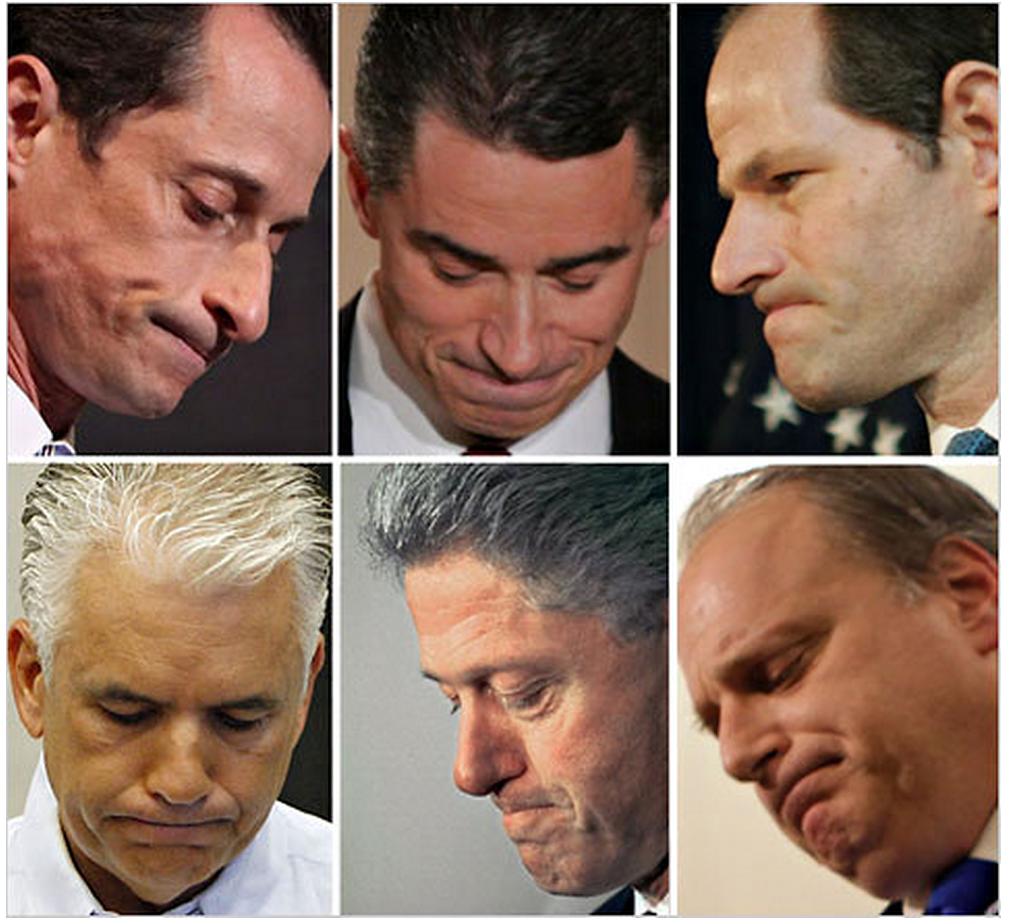
"The Look"
Clockwise from top left, Representative Anthony Weiner of New York, former Gov. James McGreevey of New Jersey, former Gov. Eliot Spitzer of New York, former Representative Eric J. Massa of New York, President Bill Clinton and former Senator John Ensign of Nevada.

I’m sure most of you will recognize these pictures, and many of you may even remember the exact moments when they were taken. Certain words immediately come to mind: disgrace, fall, scandal, regret. These eerily similar expressions all occurred during the variety of infidelity scandals that have rocked the political scene. This picture, now being called “the look,” has been floating around the internet for the last few weeks.  It provides a great opportunity for social psychologists to rally around the importance of non-verbal expressions in communication and how power can affect our emotional experience. 

The expressions of these disgraced politicians may be a bit confusing. It’s clear they express negative feelings, but which exactly? Take a second and look at them, do you feel a sense of sympathy, perhaps anger, or even suspicion? Their expressions are complicated and they say a lot. In some ways they communicate exactly what they are meant to, “I’m sorry, I’m ashamed, I’m disappointed in myself.”  But some other feelings also may be coming through, “I’m mad I got caught and I resent having to be here.” Facial expressions although they can be controlled can often be an honest communicator of our feelings, even when we don’t want them to be. To understand these expressions, let’s start at the beginning and break it down piece by piece.