Friday, November 6, 2015

Three Guys Talking About Scales

What follows below is the result of an online discussion I had with psychologists Brent Roberts (BR) and Michael Frank (MF). We discussed scale construction, and particularly, whether items with two response options (i.e., Yes v. No) are good or bad for the reliability and validity of the scale. The answers we came to surprised me--and they might surprise you too!

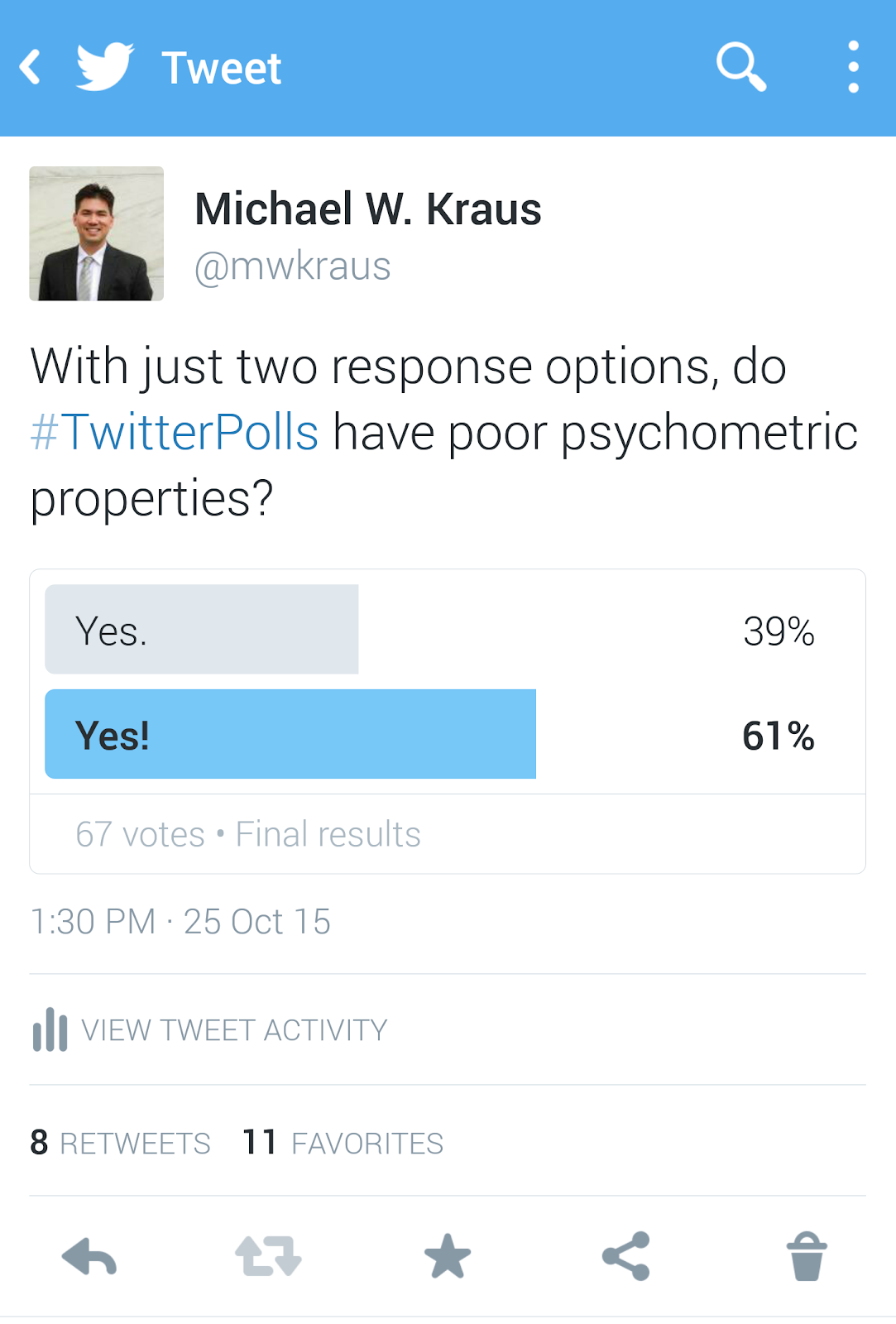
MK: Twitter recently rolled out a polling feature that allows its users to ask and answer questions of each other. The poll feature allows polling with two possible response options (e.g., Is it Fall? Yes/No). Armed with snark and some basic training in psychometrics and scale construction, I thought it would be fun to pose the following as my first poll:

Screenshot_2015-10-26-20-00-55.png

Said training suggests that, all things being equal, some people are more “Yes” or more “No” than others, so having response options that include more variety will capture more of the real variance in participant responses. To put that into an example, if I ask you if you agree with the statement: “I have high self-esteem.” A yes/no two-item response won’t capture all the true variance in people’s responses that might be otherwise captured by six items ranging from strongly disagree to strongly agree. MF/BR, is that how you would characterize your own understanding of psychometrics?

Thursday, September 24, 2015

Thought Fragments Concerning Ideology in Social Science

I took a course in sociology my first year as an undergraduate at UC Berkeley. The course was an introduction to sociology taught by professor and social activist, Harry Edwards. The course blew me away because it felt so viscerally real. Professor Edwards would talk about social class, race, and gender in America and students would chime in about their own experiences that brought these big social constructs to life. What I learned in Professor Edwards’ class resembled nothing we had discussed in my high school history classes—I grew up in a politically conservative suburb in San Diego, and we didn’t have much ideological diversity in our discussions of law and society. Sociology, and social sciences more broadly, really spoke to me.

Thursday, September 3, 2015

Parenthood can Take a Toll on Relationships, But it Doesn't have to

I became a parent a year and a half ago, and my life changed forever. When I was pregnant lots of parents gave me advice (Enjoy going to the grocery store by yourself while you still can! Go out on dates! Clean your house!). One even warned me that becoming a parent would “rock my world.” I thought I understood. I thought I was prepared for the huge change coming. And while I wasn’t unprepared, I really had no idea exactly how life-changing becoming a parent would be. Now I try to explain to my friends who don’t have children what exactly getting swept into parenthood felt like, and the best I have come up with is this—I had my daughter and she was more wonderful than I could have imagined, and the rest of my life fell into chaos. One of those pieces of my life was my relationship with my husband. We look at each other and marvel that we used to sit around on the weekend and lament that we did not know what to do with ourselves. Now we would give anything to learn the secret to freezing time. Now we try to hold on as life rushes by. Now I tell my husband we need more time and he agrees but asks, “what time?”

Tuesday, September 1, 2015

Teaching Undergrads vs. MBAs: Four Observations

Hello and sorry I've been away from blogging for so long! I ended up switching departments and jobs--now I work at Yale University at the School of Management. As you might imagine, a lot of things have changed as a result of the move. What I'd like to do today is to briefly summarize what stuck out to me as the main differences between teaching undergraduate psychology majors and first year MBAs.

A note of caution before we dive in: I've only spent about 27 hours teaching MBAs and three years teaching psychology undergraduates, so it's possible that I know little to nothing about teaching BOTH groups. Also, the undergraduates and MBAs experienced different courses and come from different universities, so the differences I observed might not reflect MBA/undergrad distinctions. What is reported here is simply one person's observations from a relatively short time period.

Monday, May 25, 2015

3 Ways Your Romantic Instincts Can Lead You Astray

When it comes to dating, we’re often told that we should trust our instincts: If it feels right, go for it, but if you get a bad feeling from someone, steer clear.

These instincts can certainly be helpful at times, but they’re also subject to a number of biases that can lead us to trust the wrong people and overlook the right ones.

Here are just three ways that our romantic instincts can lead us astray.

Friday, May 15, 2015

10 Tips for Making a Tough Decision

Source: Daniel Oines
Sometimes in life we’re faced with decisions that seem truly impossible to make. Whether they're the kind of decisions we dream about or the kind that we dread, research on decision-making has uncovered a number of useful strategies for gaining clarity.

Friday, March 27, 2015

The Benefits of Capturing your Everyday Experiences

Source
What would you rather do right now, write down the last conversation you had or watch a funny video guaranteed to make you laugh? What about a month from now – do you think you’d rather read about a random conversation you had last month or watch another funny video? These are some of the questions researchers asked in a recent set of studies exploring our tendency to underestimate how much pleasure we get out of rediscovering mundane experiences. Participants in these studies consistently expected that they would not be very interested in rereading a log of an ordinary event in their everyday lives. But a couple of months down the road when the time came to reread that log, they found themselves much more interested and experienced more pleasure than they had expected. This was partly because they had forgotten a lot more of the event than they had expected they would! In the moment, we think why record our everyday experiences, we will remember them in the future and they aren’t that memorable anyway. Even just a month later though, our memories of the event begin to dim, the details fall away, and what once seemed ordinary feels a bit more extraordinary.

Thursday, March 26, 2015

Gender Imbalance in Discussions of Best Research Practices

Over the last couple of weeks there have been some really excellent blog posts about gender representation in discussions of best research practices. The first was a shared Email correspondence between Simine Vazire and Lee Jussim. The second was a report of gender imbalance in discussions of best research practices by Alison Ledgerwood, Elizabeth Haines, and Kate Ratliff. Before then (May 2014), Sanjay Srivastava wrote about a probable diversity problem in the best practices debate. Go read these posts! I'll be here when you return.

Sunday, March 1, 2015

SPSP 2015: Actually Predicting the Future

In regression (a common statistical practice used in social science research) we often attempt to predict the outcome of a given dependent measure (the DV) based on what we know about other measured variables theoretically related to the DV (the IVs). This common regression method has one problem though: We are predicting values for data that we have already collected. What if we were to engage in actual prediction? That is, what if we attempted to predict the values of a DV that is unknown? How might we do this and what would be the benefit?

This was a fascinating talk presented by Liz Page-Gould of the University of Toronto at the Future of Social Psychology Symposium!

SPSP 2015: Status Shapes Preferences for Redistribution

A lot of people think about political ideology as a powerful causal force that influences the structure of our society and our respective positions within it. In the politics and inequality symposium Jazmin Brown-Iannuzzi of the University of North Carolina, Chapel Hill and her colleagues examined political ideology from a different perspective: Instead of shaping the structure of society, does political ideology arise from our position within that structure? That is, do we create our political beliefs strategically in order to justify our own lives and the lives of those around us?

Thursday, February 26, 2015

SPSP 2015: The world thinks that atheists are immoral

At the self and identity pre-conference this morning Will Gervais presented a series of studies (available open access right here) suggesting that people seem to automatically associate atheism with a lack of moral character.

SPSP 2015: The Contagious Spread of Affect

I was fortunate to attend the first session of the emotion pre-conference this morning and had a chance to hear about some amazing research conducted by Wendy Mendes (my post-doc advisor), Sara Waters, and Tessa West. The research examined the extent that affective states are transmitted between individuals.

The researchers reasoned that social living organisms are widely characterized by synchronous actions and states--with humans groups being particularly likely to synchronize their emotions and behaviors (here is a profound example of our capacity to synchronize during communal events).

SPSP 2015: We're here in Long Beach!

It's been a few months since I've posted on this blog, and I'm planning to change that over the next several days: It is time for the annual convention of the Society for Personality and Social Psychology and we've got three full days packed with social-personality content to share with the blogosphere. I'll be writing a few short posts over the course of the conference--but before I do I want to point out where you can find some of the current and former bloggers on this website, right here at the convention:

Thursday
Katherine Thorson: Poster Session A
Cardiac Vagal Tone predicts Responsivity to Self-Regulatory Thought Inductions: Poster A273

Friday
Amie Gordon: Symposium Session A
Bringing Sleep to Social Psychology: Considering the Effect of Sleep on our Emotions, Relationships and Intergroup Relations
Friday, February 27, 2015, 9:45 AM - 11:00 AM, Promenade Ballroom 104C


Michael Kraus: Symposium Session A
The Politics of Inequality and the Inequality of Politics
Friday, February 27, 2015, 9:45 AM - 11:00 AM, Room 203ABC


Saturday
Jennifer Stellar: Symposium Session I
A Big Helping of Humble Pie: Novel Benefits and New Methods for Cultivating Humility
Saturday, February 28, 2015, 5:00 PM - 6:15 PM, Room 103A


Maya Kuehn: Poster Session E
Rejection Resiliency and Social Influence: Poster E004 

Tuesday, October 28, 2014

Everyone Gets a Job!

A terrifying graph for any PhD student! (source)
It's late October and that means we are squarely in the middle of job season for psychology PhDs (and PhD candidates). I was hired during the 2011-2012 job cycle, and so I recently switched to the evaluation side of the job process. Sitting on this side of the fence I feel incredibly fortunate to have a job: There are a ton of accomplished graduate students and postdocs with strong records, interesting research ideas, and stellar (!!!) letters of recommendation. If the system were running optimally, most of these applicants would land jobs. If the system were running optimally...

Sunday, October 19, 2014

Does Forgiveness Have a Dark Side?

Forgiveness is widely considered to be a psychologically healthy and morally virtuous approach to coping with victimization. Research suggests that people who forgive more easily are happier and healthier than those who hold grudges. In addition, forgiveness interventions have been shown to reduce stress reactivity, increase optimism, and facilitate reconciliation with offenders.

Tuesday, October 14, 2014

What Kinds of Support Are Most Supportive?

Numerous studies have demonstrated the critical importance of social support for physical and mental health. For example, one study showed that stressed middle-aged men with higher levels of available emotional support were significantly less likely to die over a 7-year period than those who lacked such support. Another study found that an absence of social support was a major predictor of depression.

In our everyday lives, we often have opportunities to provide support to friends, family members, or coworkers, but it can be hard to know how to do it in the most effective way. Research in social psychology has revealed some principles for giving good support that challenge common assumptions. Here are three of them.  

Friday, October 3, 2014

Crossing Class Boundaries

Yesterday the New York Times published an opinion piece written by University of Toronto, Rotman School of Management Professor, Stephane Cote and I on the challenges of crossing social class boundaries. You can find the article here. This blog post accompanies that article with a few notes about the research.

Monday, August 25, 2014

Does Power Help or Hurt Perspective-Taking?


First comes love, then comes the realization that we are navigating life’s journey with another person who may have different thoughts, feelings, and beliefs than us. How do we deal with having differing viewpoints from our romantic partners? Perspective-taking is a fundamental social skill that helps us smoothly steer through the many bumps in the road, from picking out a thoughtful anniversary gift to helping us reach a compromise on a contentious issue. When people are able to consider their partner’s point of view, both they and their partners report being more satisfied with their relationship (Long, 1990). Although this basic skill is fundamental and beneficial, not everyone is good at perspective-taking, particularly in their romantic relationships (Kenny & Acitelli, 2001). So who is good at perspective-taking and who is lacking? To answer this question, I turned to the research on power. I was curious to find out whether feeling powerful in a romantic relationship might lead people to be better, or worse, perspective-takers.

Power is potent, affecting how people think, feel, and interact with others. Although thinking about powerful people might bring to mind the caricature of a power-hungry CEO, the reality is that power is not just in the workplace, it is part of all of our relationships, shaping how we interact with our parents, friends, and romantic partners. So how exactly does it shape our relationships? Or, in our case, our ability to step into our partner’s shoes? Well, the old adage, “power corrupts,” suggests that powerful people should be selfish, caring only about getting their own way and paying little attention to what their romantic partners are thinking and feeling. And there is research to support this – people are less likely to take strangers’ perspectives when they feel powerful (Galinsky et al., 2006) and in families, powerful members are less likely to perspective take (Barber, 1984). But on the other hand, for romantic relationships to survive, people can’t just be selfish—they have to think about what is best for the relationship, which means considering their partner’s point of view. Power helps people focus on and pursue their goals (Guinote, 2007), so perhaps power might actually help people become better perspective-takers in romantic relationships because it focuses them on maintaining their relationship?

Tuesday, August 19, 2014

Big Theory

"Essentially, all models are wrong, but some are useful." --George Box*

I need to be honest with you, I'm not all that good at generating novel ideas: Some of my most well-cited papers involve theories that sociologists came up with decades ago; Reviewers frequently accuse me of running post-hoc analyses (asking the data for ideas, rather than generating apriori predictions); When media cover my research, the most common initial comment is something like: "This is so obvious....blah, blah....you suck." You get the idea. 


I don't view this particular characteristic of my research as a flaw. Rather, I'm acknowledging that not all scientists can be ground-breaking theorists/game changers: Some people come up with great ideas and some people test them. For the most part, I test theories and I do it in (what I hope are) convincing ways. Given this characteristic of my research, you might be surprised then, to learn that I love theory!** 


You read that right.

Monday, August 11, 2014

Psychological Barriers in Economic Inequality Reduction

Today I wrote a blog for New Left Project on psychology research examining perceptions of, and responses to, economic inequality. The post features cutting-edge research by prominent social psychologists Mike Norton and Dan Ariely, as well as research from my own laboratory at the University of Illinois. An excerpt:

"The United States is one of the most unequal and rigidly stratified societies in the industrialised world.  In the wake of the Great Recession, it has become increasingly clear that success in America flows to the wealthy and the well-connected.  Why do these inequities persist in the face of steady unemployment, abject poverty and rising homelessness?